A Few of My Favorite Things
How the farm's second cutting of the season reminded me of loveliness.
Owner/operator, Skedaddle Sheep & Cattle
This week I published Every Wonderful Dream, an atlas of the jackrabbit homesteads of San Bernardino County, California. It maps all 20,988 tracts the federal government patented there under the Small Tract Act, most of them five acres, and it lets you follow any one of them from the survey grid to the patent and the name on it.

I bought my cabin property in Wonder Valley, east of Twentynine Palms, for back taxes at a tax-defaulted property auction. I restored the homestead cabin on it, and over the years I have added the adjacent tracts. The atlas takes its name from that valley. Being a geographer at heart and by training, I couldn’t put that much work into a five-acre rectangle of sand without wanting to know who drew the rectangle and who first held it. The atlas is what I found, for my land and for everybody else’s.
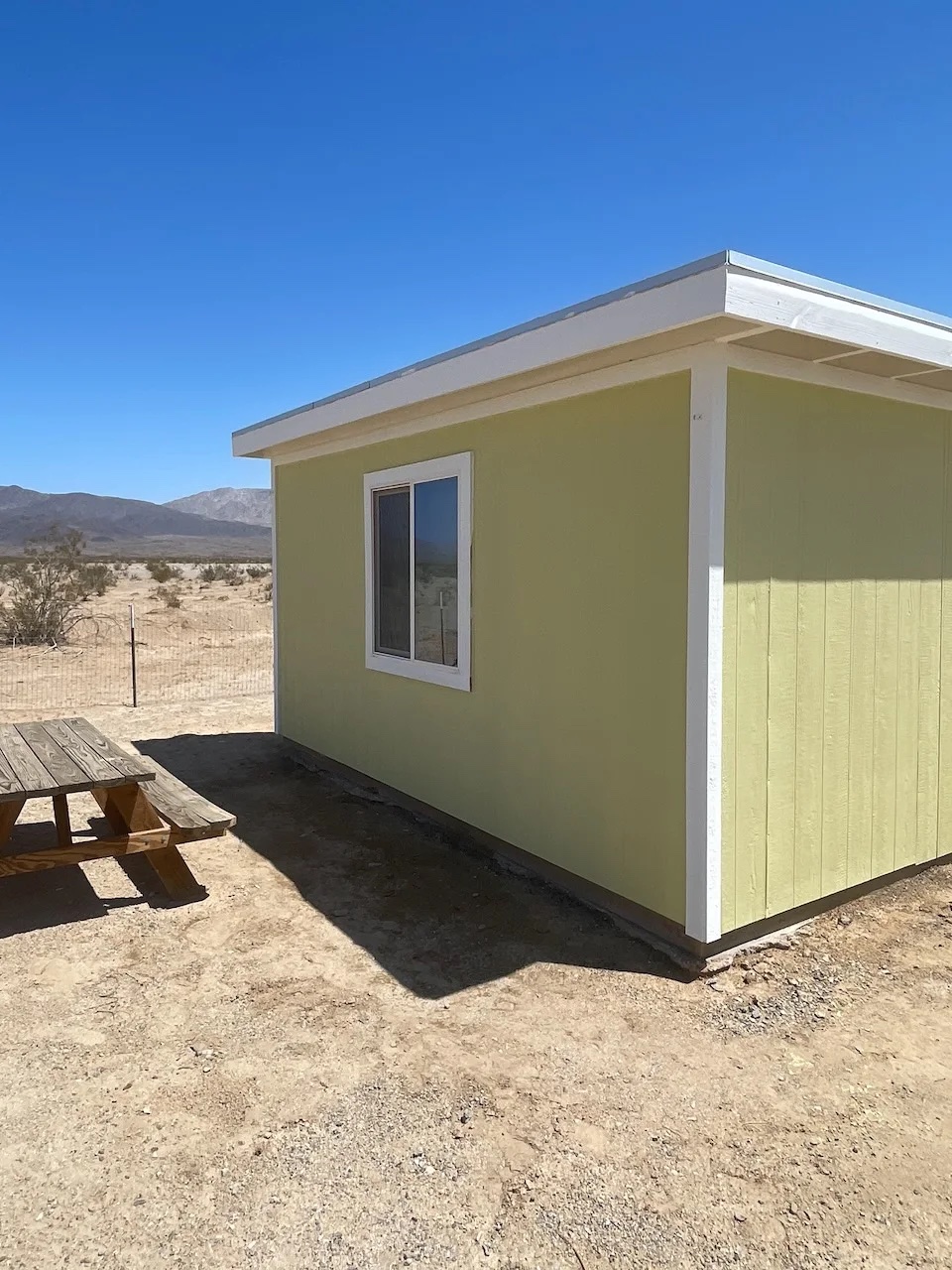
My cabin in Wonder Valley.
The Small Tract Act passed on June 1, 1938, and it was one paragraph long. It let the Secretary of the Interior sell or lease “a tract of not exceeding five acres” of public land that he classified “as chiefly valuable as a home, cabin, camp, health, convalescent, recreational, or business site.” It was not a homestead law in the old sense. Nobody had to live on the land or farm it, and the first regulations said outright that a small tract was “not intended to be devoted to producing a living.” You filed on a rectangle 330 feet by 660, leased it (for five dollars a year in the early days), built a cabin, and bought the land at its appraised price. By the fall of 1940 Desert Magazine was calling them jackrabbit homesteads, and the name stuck.
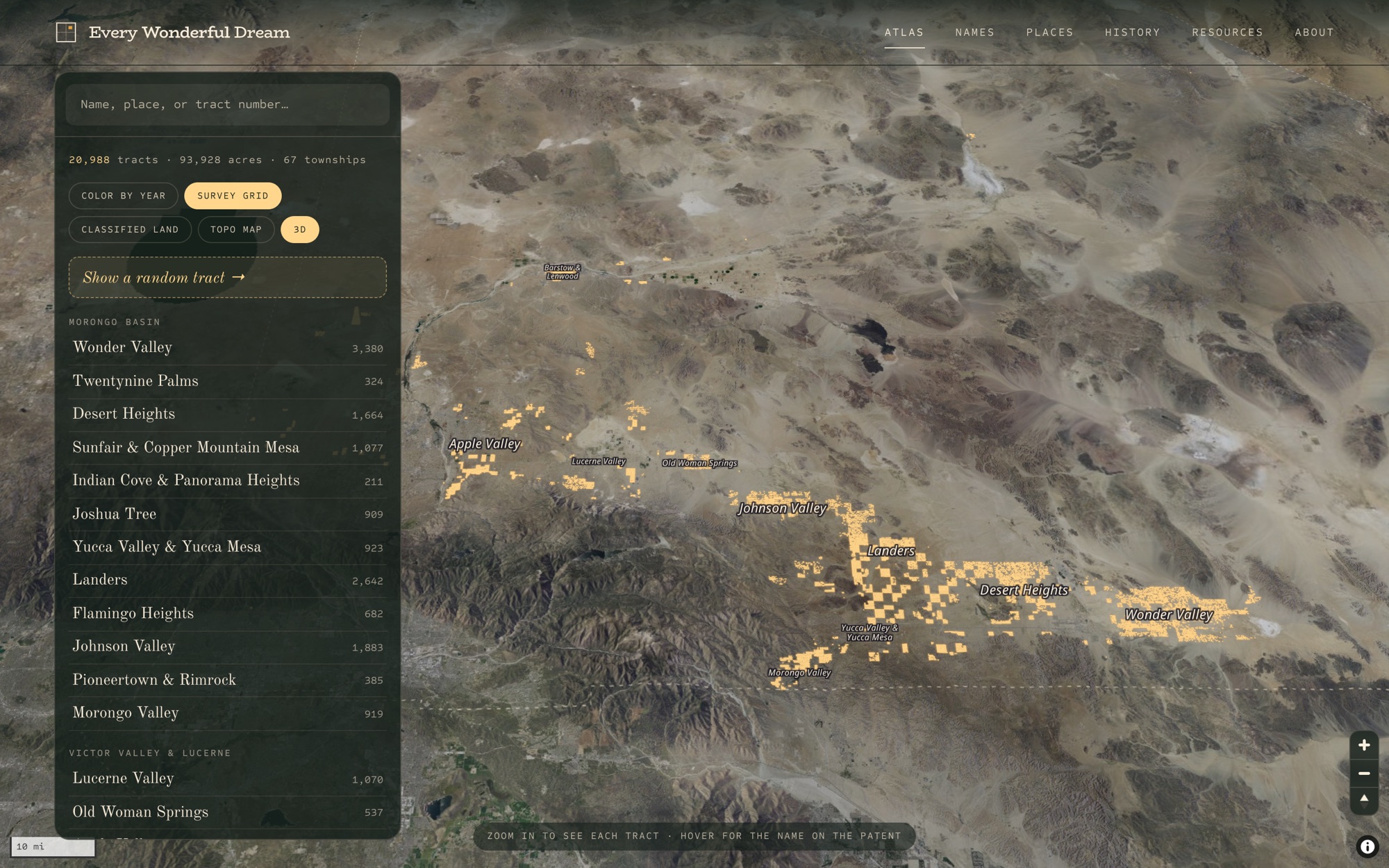
The law stayed on the books for thirty-eight years, and San Bernardino County is where most of California’s small tracts ended up. The atlas counts 20,988 patented tracts covering 93,928 acres, about three quarters of the California total. The rush was short. The land office issued 18,066 of those patents between 1955 and 1961, about 86 percent of the county’s count, and the yearly number peaked at 3,956 in 1960 before dropping sharply. Wonder Valley alone has 3,380 tracts, more than any other community in the atlas.
The map shows every tract in 3D over aerial imagery. You can search by name, place, or tract number, color the tracts by the year they were patented, and turn on the survey grid or a topo map. Zoom in and hover over a rectangle, and you get the name on its patent.
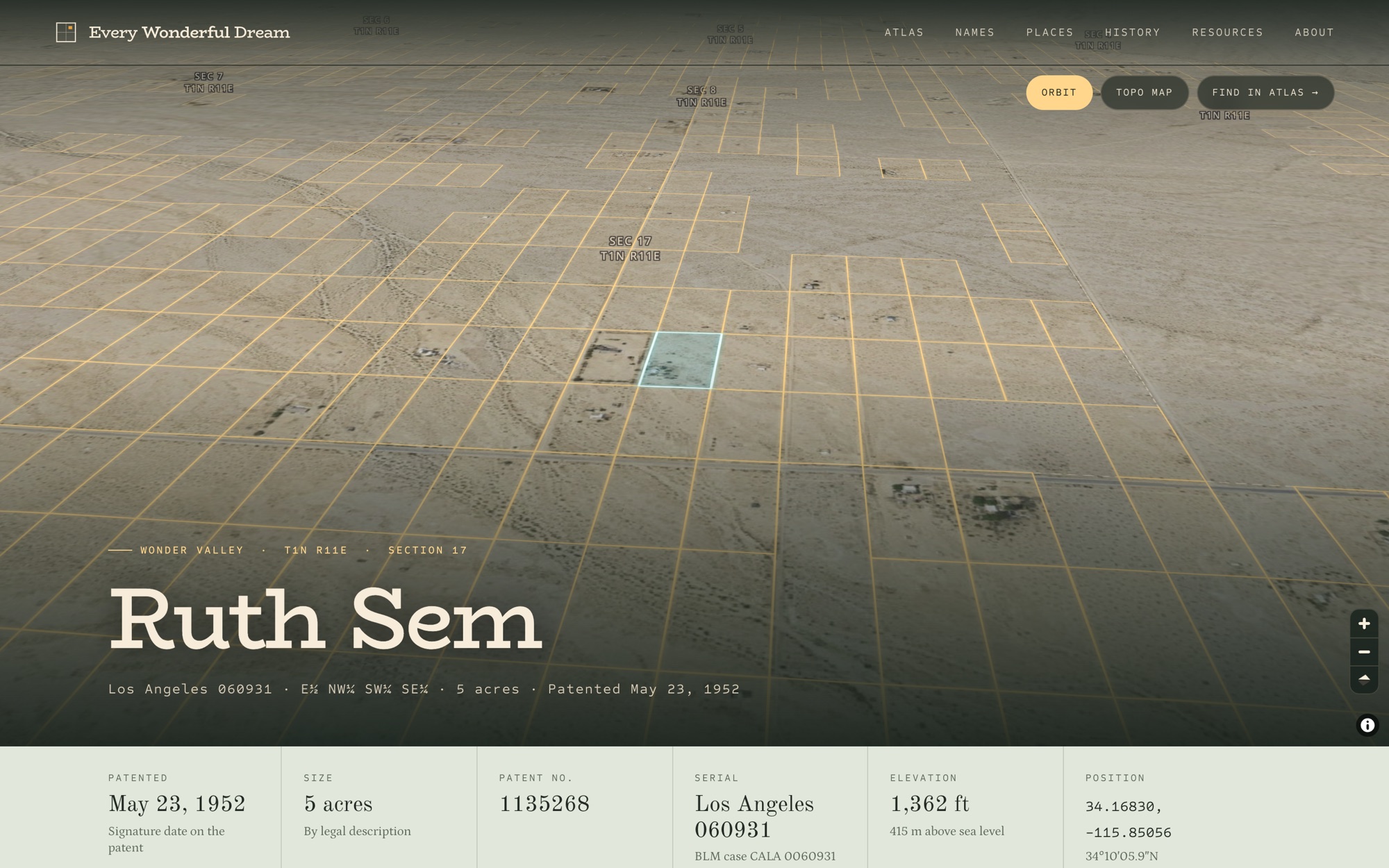
Every tract has its own page. Ruth Sem’s is the one the site uses as its worked example: five acres in Section 17, Township 1 North, Range 11 East, patented on May 23, 1952. Her page gives the legal description (E½ NW¼ SW¼ SE¼, which you read from right to left), the patent and serial numbers, the elevation, diagrams of where the tract sits in its section and township, her neighbors, and a link to the scanned patent at the Bureau of Land Management’s General Land Office Records.
There is also a name index with 22,858 names from the patents. Smith leads with 210, as you would expect, but of the 10,703 different surnames, 7,384 turn up exactly once. One corner of it lists the surnames that sound like the desert itself: eight entries for Moon, seventeen for Fox, and one each for Hare, Sunshine, and Paradise.
Places draws each of the 27 communities as a dot map of its tracts, and the history page tells the story of the Act, from the First World War veterans who came to Twentynine Palms for their lungs to the cabin demolitions around 2000 and the artists who arrived about the same time.
What I like best about this project is how much of today’s landscape is sitting right there in the paperwork.
Ruth Sem’s patent made her land subject to an easement for roadways “not exceeding 33 feet in width” along its boundaries. Put a 33-foot strip along the edges of every rectangle and you have, on paper, a public road down every line of the grid. Where somebody graded them, those lines became the washboard roads that still run to the horizon in Wonder Valley and Landers. Where nobody did, the grid exists only in the records. The road in front of my own cabin, for what it’s worth, is not one of the straight ones.
Around Landers and Joshua Tree, the tracts fall in a checkerboard instead, a square mile on and a square mile off. That pattern is older than the Act. The alternate sections had already left the public domain, most often as nineteenth-century railroad grants, so only the squares in between were the government’s to sell.
The atlas is a static site built with Astro, and the maps are drawn with MapLibre GL JS over public-domain USGS imagery and open terrain tiles. The tract outlines come from the BLM’s Mineral & Land Records System, which draws each one on the Public Land Survey grid from the legal description in its case record. The names and dates come from the BLM’s own index of California land patents, which the agency released under the Freedom of Information Act in 1997 and which Larry Vredenburgh has published ever since. Joining the two by patent number put a name and a date on 20,954 of the 20,988 tracts. The code and the data are on GitHub.
It has limits, and the About page lays them out. The patent index is all capitals, surname first, and cuts every name off at thirty characters, so the atlas reorders the names by rule and will occasionally misplace a two-word surname. It holds only what the BLM has mapped. Leases that never became patents are not in it, and by the national count more than half of the people who applied never received one. The scanned patents are linked from each tract but not yet shown on the page.
The atlas maps the tracts. For the cabins and the people in them, start with Kim Stringfellow’s Jackrabbit Homestead, which follows the Small Tract Act across the Morongo Basin in photographs, essays, and an audio tour. Her work and a good deal more are gathered on the Resources page.
If your family had a cabin out there, or if you own one now, go look up the name. And if you find something I got wrong, I’d like to hear about it. A tract’s serial number and a source are all I need to fix it.
The other day I posted a piano arrangement of Home Means Nevada, so I thought I would share the other kind of Nevada song I write. In February of last year I released my first single under the name Loneliest Road. It’s called “Rivers Die,” it runs a little over four minutes, and you can listen to it right here.
It’s also on Amazon Music, TIDAL, and Pandora, and this page gathers every link in one place.
Loneliest Road is the name I settled on for my country music songwriting project. It comes from the nickname given to Highway 50 across the middle of Nevada, which Life magazine called “the loneliest road in America” back in 1986. The magazine meant it as a warning. Nevada took it as a compliment and put it on the highway signs, and I have always been on Nevada’s side of that argument. Fallon, Austin, Eureka, Ely: it’s some of my favorite country anywhere, and it’s the country my songs come from.
Being a geographer at heart and by training, the title of the song is geography before it’s anything else. The Great Basin is the part of the country where the rivers don’t reach the sea. The Humboldt rises near Wells, runs west through Elko, and after three hundred miles of northern Nevada simply quits in a sink near Lovelock. The Truckee ends at Pyramid Lake, the Carson in its own sink, the Walker in Walker Lake. Out here a river doesn’t empty into anything. It just dies.
“Rivers Die” lives on the Humboldt, in Elko. Two women come to town for the gold and end up running loaders side by side in the pit, laughing at the men who figured they couldn’t handle it. Evenings are spent at the Star and its usual scene – buckaroos, picon punch, and more than a few miners pissing through their paychecks. Then one of them watches the other meet a buckaroo’s eyes under a dusty hat brim, and that’s the story: a love that was never going to be returned, in a place where the river was never going to reach the sea.
It’s built the way I like a country record built: acoustic guitars up front, fiddle and mandolin trading lines and adding texture, a banjo for lift and rhythm, and pedal steel underneath it all doing what pedal steel does best when you give it a sad Western story. My label, Bristlecone Artists, put it out on February 11, 2025. Since then, my production skills have improved significantly and I look forward to re-releasing it when I publish my first larger project, hopefully within the coming year.
If you listen, I’d like to hear what you think. And if it ever finds its way onto a truck stereo somewhere between Fallon and Ely on that supposedly loneliest of roads, that’s about all I could ask.
New town, new life
Elko’s dust in the air
Found work in hills of gold
hauling dirt without a care
You were behind the wheel
of another loader in the pit
We laughed at the guys
who thought we couldn’t handle it
Together we broke the mold
in a world of grit and grime
As our engines roared
our laughter echoed through the mine
I traced the Humboldt River
where the grass grows green and tall
Knew we’d never reach the sea
but I longed and hoped despite it all
In this damn Great Basin
where dreams and rivers die
My love for you was a dry mirage
a whiskey night’s goodbye
As the evening sky turned velvet
we’d bask in neon glow
Sweetbreads, red wine, and picon punch
drunks and cowboys all in a row
But when I saw the way you met his eyes
hidden beneath that dusty brim
My heart broke in silence
and dreams of gold began to dim
The high country nights grew colder
and my heart could only sigh
In the shadow of that moment
knew I had to say goodbye
I traced the Humboldt River
where the grass grows green and tall
Knew we’d never reach the sea
but I longed and hoped despite it all
In this damn Great Basin
where dreams and rivers die
My love for you was a dry mirage
a whiskey night’s goodbye
Many lonely months later
wistful tears still glaze my eyes
I dreamed of loving you
beneath endless Western skies
But in this frontier land
rivers dry and fade to brown and gray
And the love I have for you
unreturned
slips silently away
I traced the Humboldt River
where the grass grows green and tall
Knew we’d never reach the sea
but I longed and hoped despite it all
In this damn Great Basin
where dreams and rivers die
My love for you was a dry mirage
a whiskey night’s goodbye
With dust in my veins
specked with the gold that lured us here
I’ll wander ’round living ghost towns
where the past still feels too near
In the echoes of the canyons
where the coyotes serenade
I’ll find solace in the silence
and let memories of us fade
Nevada’s state song, “Home Means Nevada,” was written by Bertha Raffetto of Reno and adopted by an act of the Legislature on February 6, 1933. It’s a state song I really love, and while most long-time Nevadans can sing the chorus, the entire song is worth hearing and playing. I wasn’t able to find a decent beginner piano arrangement that included the verses as well as the chorus, so I made one.
It’s an accessible piano solo for beginner-to-intermediate players. The melody stays on top where you can hear it, the left hand keeps things simple, and the harmonies are there to support the tune rather than show off. A few notes on the page:
It sits comfortably around 100 beats per minute. You can listen to it, print it, or download it for free on MuseScore:
Home Means Nevada (Nevada State Song) on MuseScore
If you play it, I’d love to hear how it goes. I hope that by posting this online, it will become an occasional fixture of piano recitals from Elko to Yerington.
More posts
How the farm's second cutting of the season reminded me of loveliness.
The lime green iBook I got at eleven, and the childhood dream that led me to bring accelerated graphics to Mac OS 9 emulation.